In the spring of 2025, the Institute for the Study of Diplomacy (ISD) convened the Schlesinger Series in Strategic Surprises and New Global Commons working group titled “Aftershocks from Gaza.” Over two meetings, participants examined the cascading regional and global effects of the October 7 Hamas attacks and Israel’s subsequent war in Gaza.
The participants analyzed the conflict in concentric circles—from its epicenter in Gaza, Israel, Lebanon, and Syria, to its reverberations across the Middle East and into global politics. Given the rapid flow of events, Part II of Aftershocks leverages the working group’s analysis to assess the prospects and pitfalls of the 20-Point Plan for peace in Gaza, and what they portend for the future of US policy and regional stability.
Summary brief
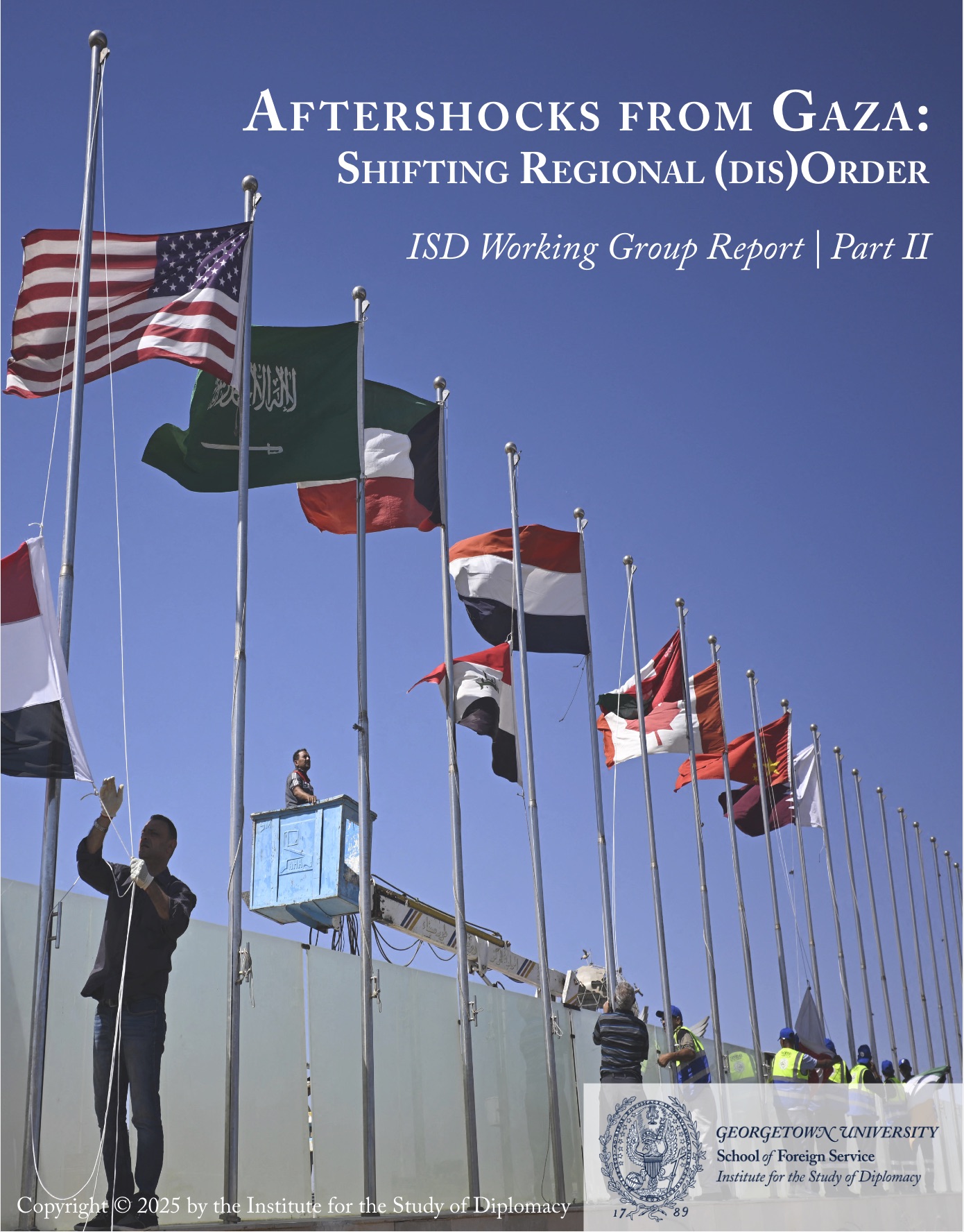
Two years of devastating war in Gaza—sparked by Hamas’ horrific terrorist attack against Israel—accelerated existing regional faultlines and have, for the moment, reached an uneasy middle ground between peace and war. President Trump’s willingness to take a tougher stance toward the Israeli government and his administration’s 20-Point Plan have demonstrated that the United States is still capable, and now, at least in the short-term, willing to use its political capital in the region. This newfound American political will must be sustained for recent gains to solidify.
Israel has become militarily dominant in the region, and acts with seemingly unfettered impunity. Israel’s attack on Qatar and the ensuing backlash from the United States underscored that the Netanyahu government can also overstep, though. Iran is arguably in its weakest regional position since the Iran-Iraq War in the 1980s. Meanwhile, the Gulf states, have demonstrated their political, economic, and diplomatic heft as middle powers. We are in a precarious moment, suspended between a longer-term ceasefire and a renewed push for peace, or renewed chaos and war.
Ultimately, a viable regional strategy must start at the epicenter — the Palestinians. US policy should prioritize tangible improvements in Palestinian governance, self-determination, personal security, and economic opportunity, laying the groundwork for broader Arab-Israeli normalization.
Another lesson from the Gaza War is, at the end of the day, that the United States cannot escape its interests and role in the region. Presidents before Trump have sought to pivot away. It rarely works. US engagement need not and should not always default to military engagement. It does require sustained political engagement.
The Gaza War and its aftershocks demonstrated that the absence of US regional leadership and responsibility is not an option. There are too many spoilers that can set off cascades of events that spin out of control. These cannot long be ignored, or left to burn out on their own. The United States has partners and friends, but as former Secretary of State George Shultz said, the garden needs to be tended.