Category: Publications
-
Case Studies
Case 359. The Road Not Taken: How the Iran-India Pipeline Fell Victim to new Delhi’s Grand Strategy Shift
This case study explores the twists and turns in India’s relations with Iran between 2005 and 2012. It is designed to illustrate the material and ideational factors that drove a rising middle power like India to make policy choices with a backdrop of a major shift in its grand strategy. A secondary focus is how the U.S. deployed diplomacy to help achieve largely favorable outcomes in a key region of the world. Negotiations for the India-Pakistan-Iran (IPI) pipeline and a proposed Liquified Natural Gas (LNG) deal form the fulcrum for process-tracing the narrative. The simultaneous narrative of the India-U.S. negotiations…
-
Case Studies
Case 360. Sports Diplomacy in Africa: The NBA and the Basketball Africa League
This case examines the creation of the Basketball Africa League and its impact on sports diplomacy. Based on the author’s experience as a historian, writer, and consultant working at the intersection of global sports, communications, and diplomacy, this case provides a framework through which students can learn about the NBA’S different basketball diplomacy efforts in Africa over time and how those efforts contribute to addressing the Sustainable Development Goals (SDGs). Sport’s ability to cut across the different SDGs makes it a uniquely valuable tool to promote stronger, more resilient communities worldwide. For example, developing a sport—increasing the number of people…
-
Case Studies
Case 361. Dollarization Diplomacy: The Case of Ecuador and El Salvador
This case examines Ecuador and El Salvador’s decision to “dollarize,” that is, to make the U.S. dollar their official currency. Britta Crandall, a visiting professor of Latin American Studies at Davidson College, explores the very different conditions and motivators that led to the decision to dollarize in each country, and how those decisions played out. The study of these two countries’ experiences lends unique insights into the factors that drove dollarization, and the limitations of this policy. Macroeconomic crisis, ideology, and specific economic interests contributed to the decisions. These cases also reveal that the decision to adopt a foreign currency—a…
-
Global Commons Working Group
Peace Through Food: Ending the Hunger-Instability Nexus
In the twentieth century, humankind made phenomenal steps to increase food production. But today, complex and interrelated issues drive an increase in food insecurity globally, and propel conflict, migration, and human insecurity. Nearly a billion people, at a minimum, are malnourished or suffer the pains of hunger—while the world wastes a third of food produced. This pain, or the fear of it, drives political instability and conflict as people seek reliable access to food. Adverse climate events, poor resource management, disease outbreaks, breakdowns in distribution, and profit-driven research and development, among other factors, have led to structural imbalances and inequities…
-
Case Studies
Case 352. Ireland’s Election to the UN Human Rights Council: Power, Influence, Reputation
Elections to UN bodies provide an important window into the work of the world’s largest and most important international organization. This case examines the role of a comparatively small state, Ireland, and its successful election to the UN Human Rights Council in November 2012.The case begins with background on the role of elections at the United Nations, both for the Human Rights Council and the Security Council. While elections to the Security Council traditionally attract the most attention, the Human Rights Council is an increasingly important venue for electoral competition among member states, and a site of significant controversies. This…
-
Case Studies
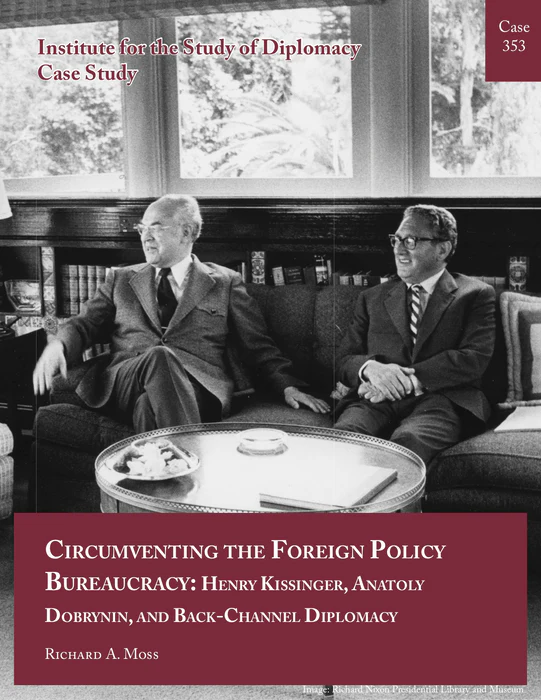
Case 353. Circumventing the Foreign Policy Bureaucracy: Henry Kissinger, Anatoly Dobrynin, and Back-Channel Diplomacy
This case study explores the back-channel relationship between Henry Kissinger, who served as Nixon’s national security advisor (and later secretary of state), and Anatoly Dobrynin, the Soviet Union’s ambassador to the United States from 1962 to 1986. During the Nixon administration (1969-1974), the Kissinger-Dobrynin channel became the primary forum for candid discussion of the major issues in superpower relations, often to the exclusion of the traditional diplomatic bureaucracy of the U.S. Department of State. The case, which is derived from the author’s book, Nixon’s Back Channel to Moscow: Confidential Diplomacy and Détente (Lexington: University Press of Kentucky, 2017), combines a detailed historical…
-
Case Studies
Case 354. Resolving the Libyan Crisis: An ISD International Negotiation Simulation
On the night of April 26, 2007, riots erupted in Tallinn, the capital of Estonia. Groups consisting largely of ethnic Russians, who make up approximately one third of Tallinn’s population, protested in the streets, clashed with police forces, and looted and destroyed stores. Two days later, once the violence subsided, one person had died, more than 150 people were injured, and 1,000 individuals were detained. Protesters took to the streets in response to the Estonian government’s announcement that it would move the statue of the “Bronze Soldier”—a Soviet war memorial—from Tallinn’s city center to a military cemetery in the suburbs. For ethnic…
-
Case Studies
Case 355. Estonia: The First Battle in the Modern Disinformation War. Lessons for Democracies Fighting Warfare
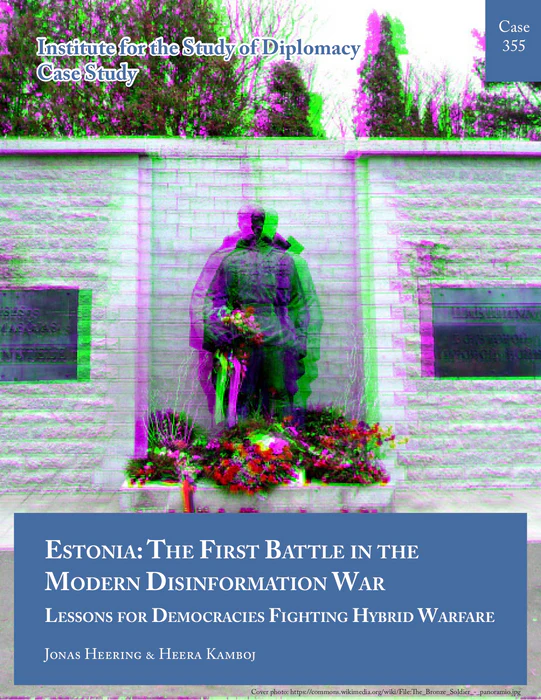
On the night of April 26, 2007, riots erupted in Tallinn, the capital of Estonia. Groups consisting largely of ethnic Russians, who make up approximately one third of Tallinn’s population, protested in the streets, clashed with police forces, and looted and destroyed stores. Two days later, once the violence subsided, one person had died, more than 150 people were injured, and 1,000 individuals were detained. Protesters took to the streets in response to the Estonian government’s announcement that it would move the statue of the “Bronze Soldier”—a Soviet war memorial—from Tallinn’s city center to a military cemetery in the suburbs. For ethnic…
-
Case Studies
Case 356. The Kashmir Back Channel: India-Pakistan Negotiations on Kashmir from 2004-2007
In early 2007, Indian and Pakistani back-channel interlocutors, appointed by the respective heads of government, were preparing to finalize a secret deal to resolve their dispute over Kashmir. Had the negotiators managed to finalize a deal, the two counties would have signed it in a public ceremony. Such a deal could have brought the decades-long Kashmir conflict to a peaceful end. However, the deal, which was confidentially negotiated in secret third country locations for a period of close to three years, was neither finalized nor signed due to domestic political upheaval in Pakistan. Successive governments in Pakistan tried to continue…
-
Case Studies
Case 357. Cyprus: Seeking Solutions. A Case Study of the 2015-2017 Negotiations
This case study examines the twenty-six months of UN-facilitated, Cypriot-led negotiations to reunify the island of Cyprus from May 2015 to July 2017. Drawing upon the author’s experience as U.S. ambassador to Cyprus during this period, the case assesses the roles and negotiating positions of the Greek Cypriot and Turkish Cypriot leaders, the United Nations, the European Union, the governments of the United Kingdom, Turkey, Greece, Russia, France, and the United States. Historically the United States has played the role of “honest broker” in negotiations over Cyprus; during this period, then Vice President Biden and later Vice President Pence took…