Category: Publications
-
Diplomatic Immunity Podcast
Patricia Owens: A History of International Thought without Men
In the first episode of our summer series, Kelly talks with Oxford University Professor Patricia Owens about her new book “Erased: A History of International Thought Without Men.” Kelly and Patricia discuss how women and minority voices were erased from the early cannon of interntional relations, what that means for the practice of IR, and how the field is fairing amid profound shifts in global order. Guest speaker Patricia Owens is a professor of international relations at the University of Oxford’s Somerville College. Her research interests include twentieth-century international history and theory, historical and contemporary practices of Anglo-American counterinsurgency and…
-
Diplomatic Immunity Podcast
Remus Ștefureac on Romania’s Election Rerun
Kelly and Tristen delve into Pope Francis’s legacy, analyze the results of the Canadian election, and examine how India is navigating trade tensions between the U.S. and China. Later, Kelly sits down with political analyst Remus Ștefureac to discuss next week’s presidential election in Romania and its implications for the country’s political trajectory and foreign policy. Guest speaker Remus is CEO and founder of INSCOP Research, one of the most respected polling firms in Romania. Previously, he was involved in the foreign service as a Romanian diplomat in Washington DC and founded the Strategic Thinking Group in 2005, a consulting…
-
Global Commons Working Group
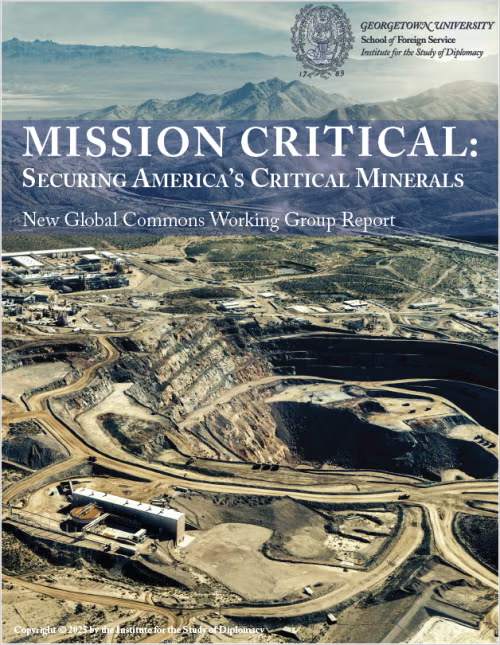
Mission Critical: Securing America’s Critical Minerals
The United States and its allies and partners face a two-pronged crisis. Increases in global temperatures call for the rapid expansion of critical mineral infrastructure—to include mines and refinement—if we hope to deploy the technology needed to avoid the worst effects of climate change. Meanwhile, the United States’ primary geopolitical adversary has obtained a near-monopoly position in the supply of most of these minerals. Heavy use of certain minerals in our defense-industrial base further underscores the need to reduce reliance on People’s Republic of China (PRC) supplies. Both our climate and our national security demand concerted efforts to wean us…
-
Diplomatic Immunity Podcast
Jeremi Suri on History & the Policymaker
For our sixth episode of “History and our Current World,” Jeremi Suri joins Kelly to discuss how policymakers can effectively use historical analogies without falling into the trap of oversimplification. They discuss how examining multiple historical cases rather than relying on a single analogy like Munich or Vietnam can result in better policy outcomes. Guest speaker Jeremi holds the Mack Brown Distinguished Chair for Leadership in Global Affairs at The University of Texas at Austin, and is a Professor in UT Austin’s Department of History and the LBJ School of Public Affairs. He is the author and editor of eleven…
-
Diplomatic Immunity Podcast
Moisés Naím on Authoritarianism
Next up this Summer, Kelly talks with bestselling author Moisés Naím about the rise of authoritarianism around the world. Guest speaker Moisés Naím is an internationally syndicated columnist and best-selling author of several books, including most recently “The Revenge of Power: How Autocrats Are Reinventing Politics for the 21st Century,” published in 2023. In the early 1990s, Dr. Naím served as Venezuela’s Minister of Trade and Industry, as director of Venezuela’s Central Bank, and as executive director of the World Bank. He was previously a professor of business and economics and dean of IESA, Venezuela’s leading business school. He now…
-
Diplomatic Immunity Podcast
Alper Coşkun on Türkiye’s Crisis of Democracy
This week is our third episode with Kelly’s new co-host, Tristen Naylor, a non-resident fellow at ISD. Kelly and Tristen give updates on renewed fighting in Gaza and how domestic Israeli politics led to the breakdown of the ceasefire. They also discuss JD Vance’s visit to Greenland and highlight some encouraging developments in India’s agricultural sector. Later, Kelly speaks with Carnegie’s Alper Coşkun about Türkiye’s escalating political turmoil. Coşkun traces the origins of the crisis and its implications for the future of Türkiye’s democracy. Guest speaker Alper is a senior fellow in the Europe Program at the Carnegie Endowment for…
-
Diplomatic Immunity Podcast
Canada, Ukraine, and South Sudan, plus Nick Thompson on Undersea Cable Attacks
This week is our second episode with Kelly’s new co-host, Tristen Naylor, a non-resident fellow at ISD. Kelly and Tristen analyze the recent conflict in South Sudan and Canadian politics, as well as the latest developments in Ukraine. Kelly then turns to Nick Thompson for an update on threats to undersea cables, including recent sabotage incidents in the Baltic Sea. They discuss how nations are strengthening their naval defenses and the challenges of attributing attacks to specific actors. Guest speaker Nick Thompson is a former CIA Paramilitary Case Officer and Naval Special Warfare Development Group operator. With over 20 years…
-
Diplomatic Immunity Podcast
Daniel Immerwahr on America’s Hidden Empire
For our fifth episode of “History and our Current World,” Daniel Immerwahr joins Kelly to uncover how U.S. foreign policy has been shaped by a hidden history of territorial expansion. They dive into the myths surrounding the U.S. “logo map” and overlooked overseas territories, and discuss how a selective understanding of this history impacts our foreign policy decisions today. Guest speaker Daniel is the Bergen Evans Professor in the Humanities and Charles Deering McCormick Professor of Teaching Excellence in the History department at Northwestern University. He is the author of Thinking Small: The United States and the Lure of Community…
-
Diplomatic Immunity Podcast
Jason Steinhauer on How Historians Must Adapt to Social Media
For our fourth episode of “History and our Current World,” Kelly welcomes author Jason Steinhauer to explore how social media has impacted historical narratives. They dive into the idea of “e-History” and how social media has made it harder for professional historians to cut through the noise in an age where misinformation is constantly competing for our attention. Guest speaker Jason formerly served as Founding Director of the Lepage Center for History in the Public Interest; as a Global Fellow at The Wilson Center and a Senior Fellow at the Foreign Policy Research Institute; and an adjunct professor at the…
-
Case Studies
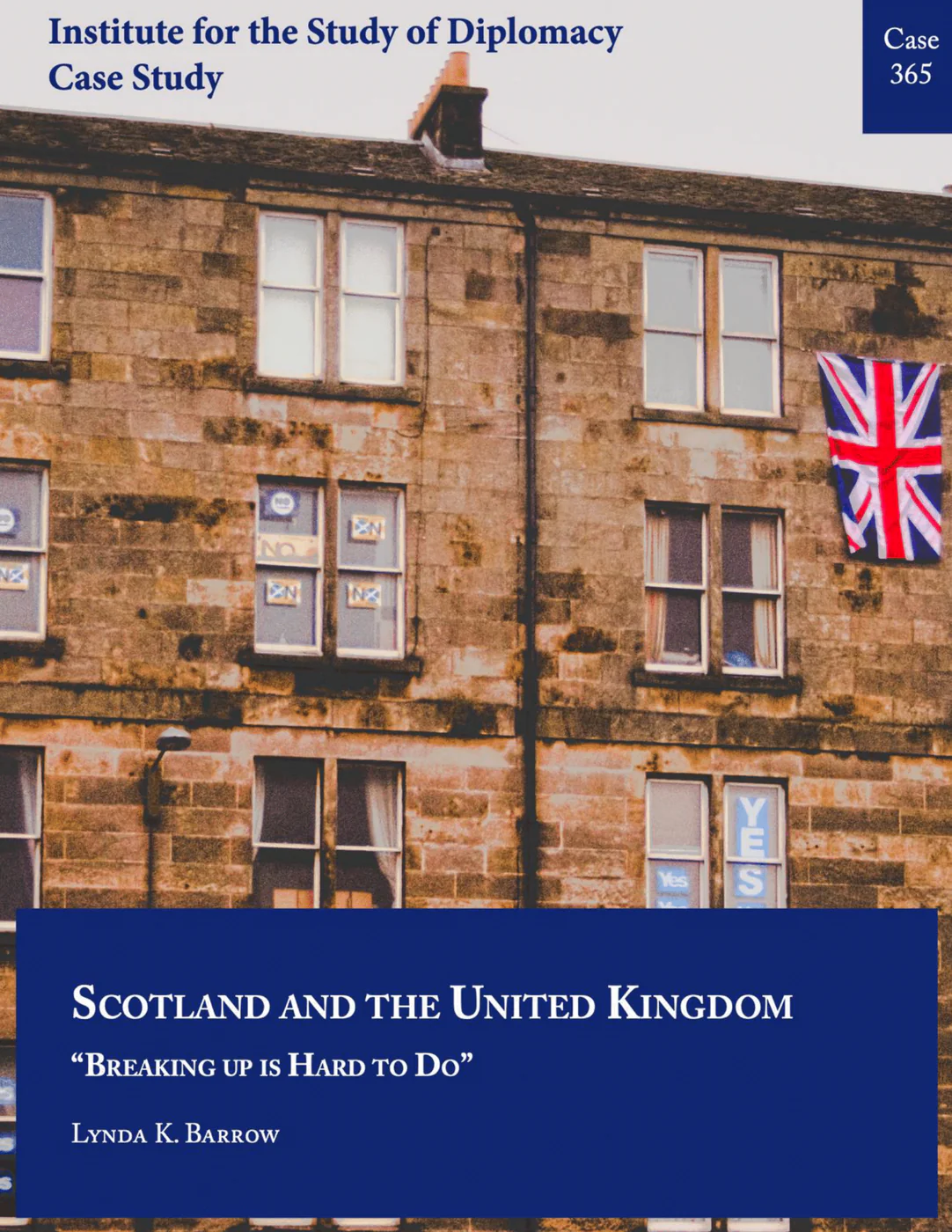
Case 365. Scotland and the United Kingdom: “Breaking up is Hard to Do”
This case examines the historical and present-day political debate around Scottish independence. Against the backdrop of Brexit, a volatile global economic and security climate, and 300 years of intimately shared history, Scotland’s independence movement had special salience in 2014 and again a decade later. The issue is whether the UK can survive as a geopolitical entity and whether Scotland can thrive as a sovereign state (or as part of the EU). How these questions are resolved could have implications for separatist drives everywhere. This case is well-suited to classes on democracy, constitutions (and concomitant distributions of power within nation-states), sovereignty,…